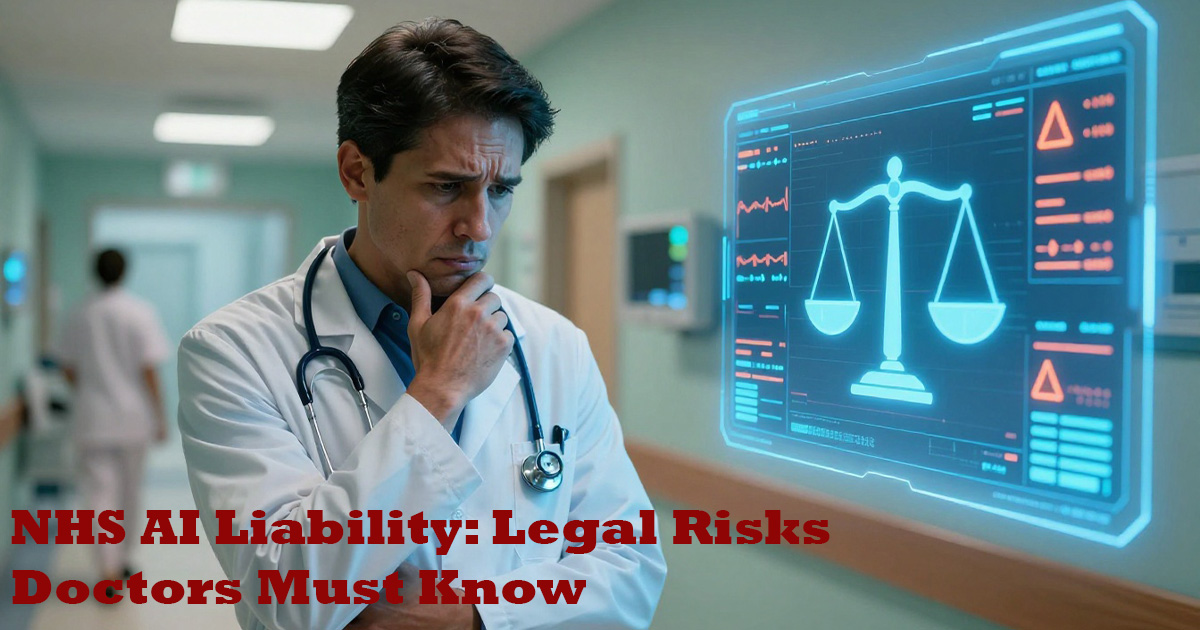
NHS AI liability is quickly becoming one of the most important legal and healthcare debates in the UK. As artificial intelligence tools become deeply integrated into hospitals, clinics, and diagnostic systems, questions around responsibility are growing louder.
Doctors are now using AI to interpret scans, generate reports, and even support treatment decisions. While this improves efficiency, it also raises a serious concern: who is legally responsible when AI gets it wrong?
This article explores the rising issue of NHS AI liability, the risks doctors face, and why current laws may not be ready for the future of healthcare.

Why NHS AI Liability Is Becoming a Major Issue
The debate around NHS AI liability is growing because AI is no longer experimental—it is actively used across the NHS.
AI systems now help with:
- X-ray and MRI analysis
- Patient triage systems
- Clinical documentation
- Administrative workload reduction
While these tools reduce pressure on staff, they also introduce new risks. When doctors rely on AI suggestions, responsibility becomes blurred.
This is why NHS AI liability is now a major policy concern in healthcare law.
The Legal Gap Behind NHS AI Liability
One of the biggest problems in NHS AI liability is that current UK law does not clearly define AI as a “product.”
Under the Consumer Protection Act 1987:
- Traditional medical devices are regulated as products
- AI software often falls into a legal grey area
- Developers may avoid full liability
This creates a gap where responsibility can shift toward doctors or NHS trusts, even when the AI system contributed to the error.
This legal uncertainty is central to the NHS AI liability debate.
Risks Doctors Face Under NHS AI Liability
The NHS AI liability issue becomes most serious when considering real-world medical risks.
For example:
- AI misses early signs of cancer in imaging scans
- Incorrect dosage recommendations lead to patient harm
- AI-generated summaries omit critical symptoms
In each case, doctors are expected to make final decisions. However, if they rely on AI outputs, they may still face legal consequences.
This creates a difficult situation where NHS AI liability could fall heavily on clinicians rather than technology developers.
Why AI Developers Avoid Responsibility
A key tension in NHS AI liability is the question of developer responsibility.
AI companies often argue:
- Their systems are decision-support tools, not decision-makers
- Doctors always retain final authority
- Liability should not extend to software providers
However, critics argue this is unfair because:
- AI influences clinical decisions
- Doctors rely on system outputs under pressure
- Errors can originate from algorithm design
This imbalance is a major reason why NHS AI liability remains unresolved.

NHS AI Expansion and Rising Concerns
AI adoption in the NHS is accelerating rapidly. More than 500,000 staff now have access to AI-assisted tools for administrative and clinical tasks.
While this improves efficiency, it also increases exposure to risk.
Concerns linked to NHS AI liability include:
- Over-reliance on automated recommendations
- Reduced independent clinical judgment
- Lack of transparency in AI decision-making
Doctors may feel pressured to trust AI outputs, especially in high-demand environments.
This makes NHS AI liability a growing operational and legal challenge.
Government Response to NHS AI Liability
The UK government is beginning to address NHS AI liability, but progress is slow.
Current actions include:
- NHS Resolution drafting AI negligence guidance
- Law Commission reviewing product liability laws
- Discussions on whether AI should be legally classified as a product
However, no final legislation has been passed yet.
Experts warn that delays could leave clinicians exposed as AI adoption continues to grow across healthcare systems.
Future of NHS AI Liability in Healthcare
The future of NHS AI liability will depend on how quickly laws evolve.
Possible changes include:
- Clear classification of AI as a legal product
- Shared liability between developers and healthcare providers
- Stronger regulatory frameworks for medical AI systems
If reforms succeed, responsibility will be more fairly distributed, reducing pressure on individual doctors.
If not, NHS AI liability could continue to place doctors at the center of legal risk even when they are not the root cause of errors.
About the Author