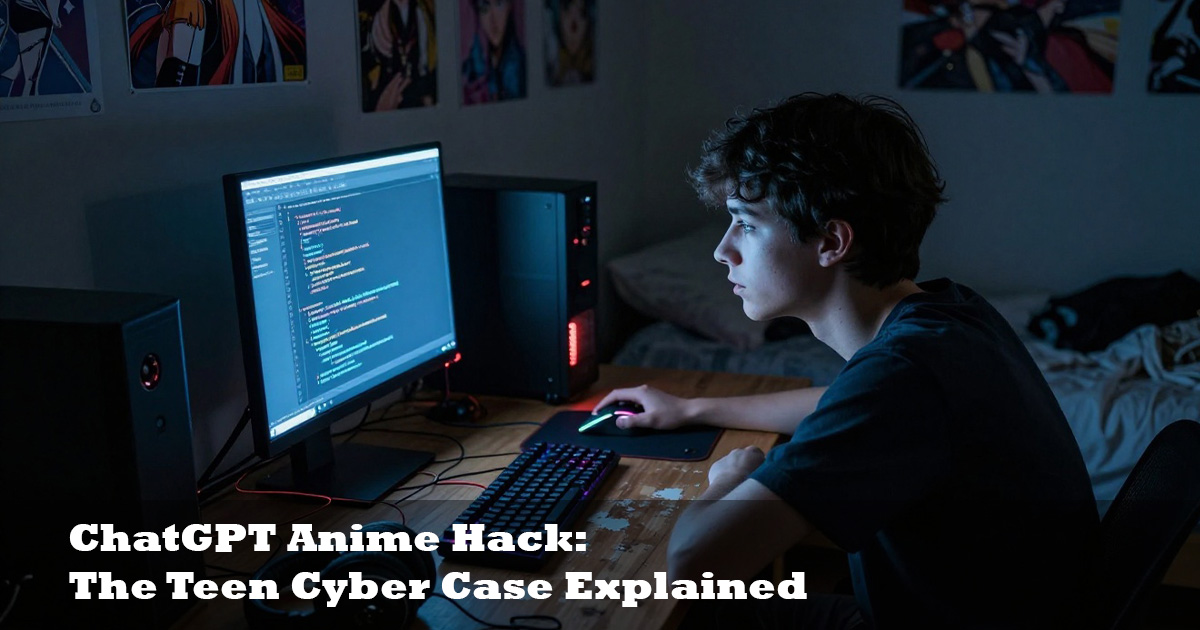
Artificial intelligence is changing the way people work, learn, and create. However, the recent ChatGPT Anime Hack case in Japan has also sparked an important conversation about how AI can be misused when combined with existing cybersecurity weaknesses.
Japanese police arrested a 15-year-old high school student after he allegedly exploited a vulnerability in Bandai Channel, an anime streaming platform. Authorities say the teenager used his own programming skills and ChatGPT to improve the speed of his code, eventually triggering the cancellation of 46,812 paid user subscriptions.
While the headline may sound like AI carried out the attack, the reality is far more complex. The incident highlights the importance of secure software, responsible AI use, and stronger cybersecurity practices.
What Happened in the ChatGPT Anime Hack Case?
The ChatGPT Anime Hack centers around an alleged cyberattack against Bandai Channel, a popular anime streaming service in Japan.
According to police, the teenager discovered a security flaw that allowed him to send fraudulent commands to the platform. Between 5:00 p.m. and 8:45 p.m. on November 4, 2025, those commands automatically canceled tens of thousands of active subscriptions.
The disruption temporarily affected the company’s services and forced Bandai Channel to begin a large-scale recovery effort.
Although the number of affected accounts was massive, investigators stated there is currently no evidence that customer information was publicly leaked.
How the ChatGPT Anime Hack Disrupted 46,812 Anime Subscriptions
Authorities believe the teenager first wrote the attack script himself.
However, during questioning, he reportedly admitted that the original program was too slow. He then asked ChatGPT for help converting the script into a faster programming language.
The optimized version made the automated process much more efficient.
Investigators also said he repeatedly changed IP addresses whenever one became blocked. Reports suggest this happened around 30 times during the attack.
This demonstrates that the attack relied on several technical actions rather than AI alone.
A Vulnerable System Played a Major Role
One of the biggest lessons from the ChatGPT Anime Hack is that the platform reportedly contained an exploitable security weakness.
Without that vulnerability, the automated attack would likely have been much harder—or impossible—to perform.
Cybersecurity experts often emphasize that attackers succeed because systems have weaknesses, not simply because better tools exist.
Why ChatGPT Became Part of the ChatGPT Anime Hack Story
Many headlines focused heavily on ChatGPT.
That attention is understandable because generative AI remains a new and rapidly evolving technology.
However, reports indicate ChatGPT was used mainly as a coding assistant rather than as the planner of the attack.
The teenager already knew how to program and had reportedly been teaching himself coding since elementary school.
Instead of creating the entire attack, AI reportedly helped improve code performance.
This distinction matters because it shows that AI tools can accelerate existing skills, whether they are used for positive or harmful purposes.
Bandai Channel’s Response After the ChatGPT Anime Hack
Following the incident, Bandai Channel quickly began recovery efforts.
The company reportedly:
- Contacted affected users individually.
- Refunded subscription charges affected by the disruption.
- Warned customers about possible phishing attempts.
- Asked users to re-register where necessary.
- Hired cybersecurity specialists to review its systems.
- Began additional security monitoring.
These actions helped restore customer confidence while reducing the risk of future attacks.
Strong communication after a security incident is often just as important as fixing the technical problem itself.
Legal Consequences After the ChatGPT Anime Hack
Japanese law allows criminal prosecution for suspects aged 14 and older.
The 15-year-old is expected to appear before a family court, where a judge will determine whether the case should proceed to criminal prosecution.
Possible allegations include:
- Unauthorized computer access
- Fraudulent obstruction of business
- Violations of Japan’s computer access laws
Authorities also noted that the suspect had reportedly been investigated previously for logging into multiple accounts using stolen credentials.
If proven in court, those previous allegations could influence the overall case.
Lessons Businesses Can Learn From the ChatGPT Anime Hack
The ChatGPT Anime Hack offers several valuable lessons for organizations of every size.
1. Fix Vulnerabilities Quickly
Every software system contains potential weaknesses.
Regular security testing and prompt patching reduce opportunities for attackers.
2. Monitor Unusual Activity
Large numbers of automated requests should trigger immediate alerts.
Real-time monitoring allows companies to stop attacks before they grow.
3. Use Multi-Layer Security
Firewalls, rate limiting, authentication controls, and behavioral monitoring work best when combined.
No single security tool is enough.
4. Train Employees
Security is not only a technical issue.
Employees should recognize phishing attempts, suspicious activity, and unusual account behavior.
5. Prepare an Incident Response Plan
Every company should know exactly how to respond when an attack occurs.
Fast communication and organized recovery reduce long-term damage.
What This Means for AI and Cybersecurity
The ChatGPT Anime Hack should not be viewed as proof that AI itself is dangerous.
Instead, it highlights an important reality.
Artificial intelligence is a tool.
Like many technologies, it can support productive work or be misused depending on how people choose to use it.
Developers use AI to write software faster.
Businesses use AI to improve customer service.
Researchers use AI to solve complex problems.
Unfortunately, some individuals may also attempt to misuse these capabilities.
That is why responsible AI development must go hand in hand with strong cybersecurity practices and user education.

Practical Advice for Online Users
Even if you are not a programmer, there are several ways to protect your online accounts:
- Use strong, unique passwords.
- Enable two-factor authentication whenever possible.
- Watch for phishing emails after security incidents.
- Update passwords if a service reports suspicious activity.
- Avoid reusing the same login credentials across multiple websites.
These simple habits greatly reduce personal cybersecurity risks.
The ChatGPT Anime Hack is ultimately a story about cybersecurity rather than artificial intelligence alone.
According to investigators, a skilled teenager combined programming knowledge, an existing system vulnerability, and AI-assisted coding to carry out a large-scale disruption affecting more than 46,000 subscriptions.
The incident reminds businesses to strengthen their digital defenses while encouraging responsible use of emerging technologies.
As AI continues to evolve, organizations and individuals alike must focus on secure systems, ethical innovation, and ongoing cybersecurity awareness. Those lessons will remain valuable long after the headlines surrounding the ChatGPT Anime Hack fade.
About the Author